
Emotional overhead in leadership is rarely listed in a job description.
Your title says CEO.
Your calendar says back-to-back calls.
Your brain says keep it together.
But under the surface, you are managing far more than tasks.
You are managing tone. Reactions. Energy. Anxiety. Conflict. Expectations. Disappointment. Fragile egos. Your own regulation.
This is emotional overhead in leadership.
And it is one of the most underexamined drivers of executive fatigue.
Jump ahead
What Is Emotional Overhead in Leadership?
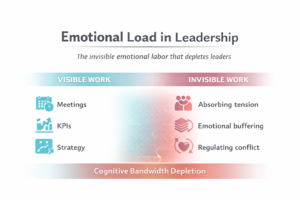
Emotional overhead in leadership is the invisible work required to stay composed, absorb tension, regulate reactions, and create psychological safety for others.
It looks like:
- Smiling through stress so your team does not spiral
- Editing your feedback so it lands without destabilizing morale
- Holding steady while others react emotionally
- Carrying difficult decisions alone to protect the group
- Buffering anxiety from investors, clients, or senior leadership
None of this appears on a task list. Yet it consumes real cognitive and emotional bandwidth.
Emotional overhead in leadership is not weakness. It is emotional labor performed at a high level. The issue is not whether you do it. The issue is how much you carry without recalibration.
Why Emotional Overhead Drains High Performers
High performers are particularly susceptible to emotional overhead in leadership.
You were rewarded for composure early. You became the steady one. The reliable one. The one who could handle complexity without visible strain.
Over time, that reputation becomes an expectation. And expectations become identity.
The more competent you are, the more emotional load you absorb.
This is where emotional overhead begins compounding with other invisible forces, such as inertia in leadership. You continue carrying the emotional pattern because it has worked before, even if it no longer serves your capacity.
Eventually, the cost shows up as:
- Reduced patience
- Decision fatigue
- Emotional detachment
- Shortened creativity
- Quiet resentment
Not because you lack care, but because your internal bandwidth is overextended.
The Neuroscience of Emotional Regulation
Emotional overhead in leadership is neurologically expensive.
Emotional regulation requires activation of the prefrontal cortex to modulate limbic system responses. When leaders repeatedly suppress or buffer emotional reactions, cognitive resources are diverted from strategic thinking toward regulation.
The American Psychological Association has documented how chronic stress impairs executive functioning and working memory:
American Psychological Association – Stress and Executive Function
This means emotional overhead in leadership does not just feel tiring. It measurably narrows strategic capacity.
The more energy spent stabilizing others, the less energy remains for vision, creativity, and calibrated decision-making.
Leadership journal reflection
“What am I carrying that is not mine?”
- Where am I absorbing tension instead of delegating responsibility?
- What emotions do I consistently buffer for others?
- What conversations am I postponing to protect comfort?
- What would shift if I trusted others to handle their own reactions?
Be the most current leader in the room, in five minutes a week.
You already search for this, save the posts, and mean to get to the book. I read across the research and the noise, throw out what just sounds wise, and hand you the one idea that holds up.
How Emotional Overhead Shows Up Organizationally
Emotional overhead in leadership does not stay contained within the individual.
When leaders over-carry emotional labor, teams often under-develop emotional resilience. The leader becomes the regulator for the entire system.
This creates dependency.
Over time, that dependency slows decision cycles, weakens ownership, and increases the leader’s internal pressure.
Sustainable leadership requires distributing emotional responsibility appropriately, not hoarding it.
Reducing Emotional Overhead Without Losing Authority
Reducing emotional overhead in leadership does not mean becoming cold or detached.
It means:
- Clarifying emotional boundaries
- Allowing discomfort without rescuing
- Separating empathy from over-identification
- Building regulation capacity instead of suppressing reaction
This is not a mindset shift alone. It is nervous system work, boundary design, and identity recalibration.
Executive coaching creates structured space to unpack the patterns you have been rewarded for but never examined.
Next Steps
Emotional overhead in leadership is real. It is invisible. And it compounds quietly.
If you are holding more than anyone sees and your internal bandwidth feels narrower than your title suggests, it may be time to reassess how much emotional labor you are carrying by default.
Executive coaching provides a confidential, strategic environment to recalibrate your emotional capacity, leadership boundaries, and cognitive clarity without sacrificing performance.
Explore executive coaching here:
https://kabrinaashley.com/coaching/